Stop the Numbers: Testing vs. Teaching
It’s time to trust teachers and students again

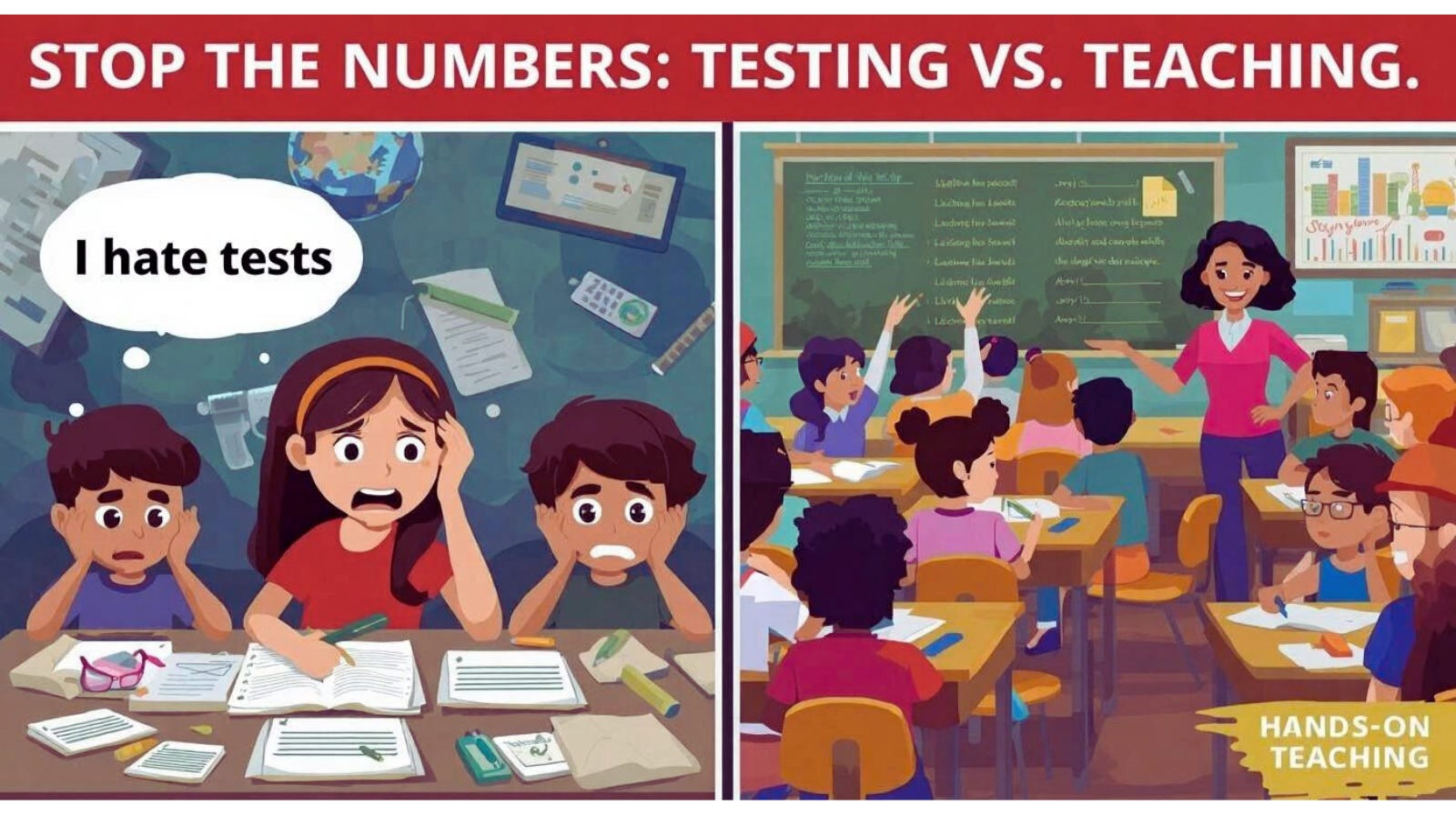
We live in a world that loves a number. How many followers, how many likes, how many steps, how many cups of coffee. In schools, that addiction to quantification has metastasized into an obsession: scores, proficiency percentages, growth percentiles, “college-and-career ready” cut points, kindergarten-entry benchmarks, interim benchmarks, exit exams. Everywhere a number, and nowhere enough attention to the kid behind the number.
This isn’t just an aesthetic objection. The way we assess students shapes what happens in classrooms. High-stakes, over-frequent, one-size-fits-all testing narrows curricula, squeezes out play and creativity, and funnels schools into teaching to the test rather than teaching children. Worse, tests designed to produce neat categories of “proficient” vs. “not yet proficient” reduce human beings to digits on a spreadsheet. That must stop.
This essay walks through what testing the federal government actually requires, how states add layers on top of that, and, most importantly, how we can get back to letting teachers teach and children thrive.
What the federal government actually requires
The Every Student Succeeds Act (ESSA) is the federal law that currently governs K–12 testing requirements. ESSA requires states to administer annual statewide assessments in reading/language arts and mathematics for every student in grades 3–8 and at least once in high school. ESSA also requires that science be assessed at least once in each of the grade bands 3–5, 6–9, and 10–12. States have some flexibility in how they design assessments, but annual ELA/math testing in those elementary and middle grades and once in high school remains the federal floor. U.S. Department of Education+1
Beyond ESSA, the National Assessment of Educational Progress (NAEP), “the Nation’s Report Card”, is a congressionally mandated, periodic assessment administered by the National Center for Education Statistics. NAEP is not a classroom-level, year-to-year accountability tool; it provides periodic snapshots of achievement nationwide and across states. National Center for Education Statistics
Two important clarifications:
ESSA applies to states, not to individual teachers or classrooms. It sets minimum requirements that every state must meet to receive federal Title I funding, but it leaves considerable discretion to states and districts regarding additional assessments, accountability systems, and graduation requirements. U.S. Department of Education
States can and do layer on more tests. High school exit exams, locally required interim benchmarks, early-childhood screening tools, industry certification exams, Advanced Placement, IB, state performance tasks, and local diagnostic tests are often added by states and districts. Those additional assessments may be useful in some contexts, but they are not federally required. scillsspartners.org+1
Which tests are mandatory and which are not, the short list
Federally required (via ESSA):
ELA and Math: annual statewide tests for all students in grades 3–8 and once in high school. U.S. Department of Education
Science: at least once in each of the three grade bands (3–5, 6–9, 10–12). U.S. Department of Education
Federally authorized and national but not classroom-mandated:
NAEP, periodic national assessment for monitoring trends, not used for individual student promotion. National Center for Education Statistics
Mostly state/district decisions (vary widely by state/district):
High school graduation exams or exit requirements (some states still require them; others are eliminating them or offering alternatives). AP News
Kindergarten-entry assessments (some states/districts require screening or entry assessment; these vary a great deal). Learning Policy Institute
Interim benchmark tests (district/state-designed). U.S. Department of Education
Local reading/math screeners, placement exams, and specialty assessments (AP, IB, industry certs, English learner/caregiver diagnostics). Connecticut General Assembly
Opting out: Rules on whether parents or districts can refuse state tests vary by state. Some states permit opt-outs or refusals, others prohibit them, and many leave the decision to local districts. If you’re a parent or educator wondering about opt-out options, check your state education agency or NASBE’s summary of state policies. nasbe.org+1
How testing proliferated — and why that matters
ESSA preserved annual testing in the early grades but also gave states flexibility to redesign assessments, which many states and districts have interpreted as permission to add more assessments: interim assessments for accountability and instruction, kindergarten-entry screenings, college- and career-readiness exams, performance tasks, and vendor-driven “benchmark” packages. What began as a federal effort to ensure equity and monitor progress has ballooned into a testing industrial complex.
The result: teachers spend precious instructional time administering, preparing for, and remediating to tests. Younger children see play, exploration, and project-based learning displaced by skill drills. Families feel pressure, and students, especially those from historically marginalized groups, are too often reduced to a single test score that fails to capture the breadth of their abilities. Research and practitioner reports document both the harms (narrowing curricula, stress, misaligned instruction) and the potential uses of good assessment when used sparingly and thoughtfully. ERIC+1
A recent national trend bears noting: several states and large districts are rethinking or reducing exit-exam graduation requirements and piloting alternatives, recognizing that a single standardized test is a blunt instrument for measuring readiness. The change shows the system is willing to course-correct when policy and practice don’t match student needs. AP News+1
Kindergarten, testing, and the loss of childhood play
“Kindergarten for all” has become a slogan of commitment to early learning access, and rightly so. Universal access to high-quality early childhood education is an equity imperative. But access is not the same thing as turning kindergarten into a test-prep factory.
High-quality early childhood practice is play-based, developmentally appropriate, and focused on socio-emotional skills, language, and curiosity. Extensive research shows that playful, guided activities in early childhood are highly effective at building foundational skills, often more so than tightly scripted instruction or early standardized testing. Over-testing young children undermines these gains by prioritizing discrete, testable skills over the whole child. Education Week+1
The human cost: why teachers and students are pleading for relief
Teachers, the professionals we trust to know children, have increasingly told me (and the research supports this) that the proliferation of assessments eats into the time they need for meaningful instruction, formative feedback, and relationship-building. When the metric is a score, not growth or strengths, instruction curdles into drill. When a kindergarten teacher is judged by a percent proficient number, playtime becomes expendable.
Students pay the price. High-stakes tests heighten anxiety; early and frequent testing reshapes children’s relationships with learning. Children who would flourish in project-based, arts-rich, or hands-on environments may never have the chance to discover that they are a writer, a mechanic, an artist, an entrepreneur, or, yes, a scientist who learns best by doing. The totalizing focus on “you are a number” flattens potential. ERIC
What should change? A practical agenda to rebalance assessment and instruction
We must preserve the useful functions of assessment, equity monitoring, accountability for underserved students, and actionable diagnostic information, while stripping away the excess. Here’s a practical policy and practice agenda:
Honor the federal floor; stop making it the ceiling. ESSA already sets minimum testing requirements. States should avoid expanding required statewide testing beyond ESSA’s purposes unless there is clear evidence that a new test improves instruction and student outcomes. U.S. Department of Education+1
Limit testing time and protect instruction. Districts should set strict caps on the number of days and hours devoted to mandated testing and vendor benchmark tests. Time-on-task matters; instruction should be the priority.
Shift from punitive, single-score accountability to richer, multiple measures. Use portfolios, capstone projects, teacher assessments, and community-verified performance tasks as alternatives or complements to standardized tests, especially for graduation and course credit decisions. Several districts and states are piloting such alternatives now. AP News+1
End high-stakes testing in early childhood and preserve play-based kindergarten. Kindergarten should focus on developmentally appropriate practice. Use classroom-based formative tools for screening and supports, not standardized, high-stakes instruments that narrow learning. Education Week+1
Return judgment about instruction to teachers. Empower teachers with high-quality formative assessments and professional learning, not top-down mandates. Build trust in teacher judgment by investing in their training and collaborative time to analyze assessment data meaningfully.
Make assessment transparent and locally useful. Assessment results should be timely, actionable, and presented in ways that families and teachers can use to support students, not as public shaming metrics. Data must inform supports, not punish schools serving students with greater needs.
Mandate periodic policy reviews. States should commit to periodic reviews (with stakeholders) of the total testing burden on students and teachers and publicly report the time and money spent on assessments and test prep.
Answers, not indignation: how to implement change in a messy political world
Policy change will require both empirical work and political courage. Here are practical levers:
Pilot alternatives. Districts like LAUSD have begun piloting schools exempt from some standardized tests when they implement rigorous alternatives. These pilots create the evidence base for larger reforms. New York Post
Engage teachers, families, and communities. Policymakers should convene cross-sector advisory groups to define “rigorous” beyond a test score, including arts, civic projects, internships, and portfolios.
Protect vulnerable students. Any move away from tests must preserve mechanisms that identify and direct supports to students who have been historically underserved. The goal isn’t to eliminate accountability; it’s to make it smarter and more humane.
Conclusion let’s measure what matters
Numbers can help us see patterns, identify inequities, and measure progress. But when numbers become the masters instead of tools, we lose sight of the end they were meant to serve: preparing whole human beings for lives of purpose, work, and civic participation.
We need far fewer tests that exist to feed systems and markets, and far more time, trust, and resources invested in teachers and in the real, messy work of education: relationships, curiosity, play, mentorship, apprenticeship, and delight. Let’s stop telling children who they are by a single score and start helping them become the people they were meant to be.
Key sources and further reading
U.S. Department of Education, Every Student Succeeds Act (ESSA) (overview and guidance). U.S. Department of Education+1
U.S. Department of Education, ESSA assessment factsheet and regulatory summary. U.S. Department of Education
National Center for Education Statistics, NAEP and state assessments. National Center for Education Statistics
National Association of State Boards of Education (NASBE), Opt-out policies by state. nasbe.org
Learning Policy Institute, Research brief on high-quality early childhood assessment and considerations for kindergarten screening and assessment. Learning Policy Institute
Education Week, Play-based learning in kindergarten (evidence and trends). Education Week
Associated Press, Coverage on states moving away from standardized graduation exam requirements. AP News
Citizens for Public Schools / Opt-out resources (overview for families and activists). Citizens for Public Schools